 GymTraining
Why Did Your Weight Go Up Overnight? (It's Probably Not Body Fat)
The scale jumped a kilo or two overnight even though your training and diet haven’t changed? Here’s what water, glycogen, sodium and your cycle have to do with it — and when a gain actually means fat.
Yesterday your weight looked perfectly normal. This morning, the scale is suddenly one or two pounds higher. You didn't skip your workouts, overeat all week, or abandon your nutrition plan—so what happened?
In most cases, an overnight increase on the scale has little to do with gaining body fat. Temporary weight fluctuations are commonly caused by water retention, glycogen storage, salty meals, food still moving through your digestive system, post-workout recovery, or hormonal changes during your menstrual cycle.
Before slashing calories, cutting carbs, or adding extra cardio, it's worth understanding what actually caused the number on the scale to change.
What Does the Scale Actually Measure?
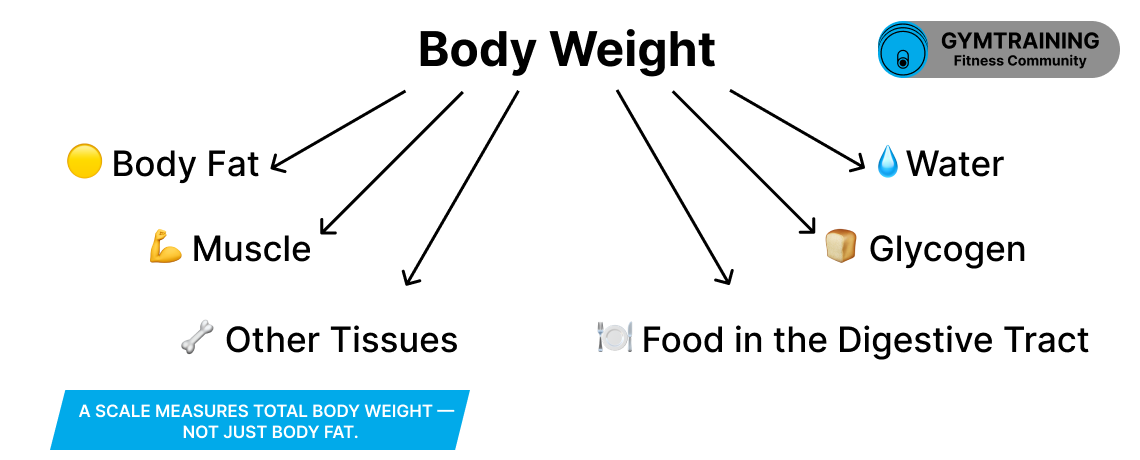
Your bathroom scale measures total body weight—not just body fat.
It cannot distinguish between fat, muscle, water, glycogen, food you've recently eaten, or waste still in your digestive tract.
Your weight at any given moment is influenced by several factors, including:
- how much water your body is holding;
- glycogen stored in your muscles and liver;
- food and drinks still being digested;
- bowel contents;
- recovery from recent exercise;
- hormonal fluctuations;
- the time of day and your weighing conditions.
Most of these factors can change much faster than body fat.
The scale isn't lying—it simply can't tell you why your weight changed.
1. Salty Foods and Water Retention
One of the most common situations looks like this: you enjoy pizza, sushi, restaurant food, or salty snacks in the evening, then wake up the next morning weighing noticeably more.
That doesn't necessarily mean you've gained fat.
Sodium plays an essential role in regulating fluid balance, nerve function, and muscle contractions. After eating much more salt than usual, your body may temporarily retain extra water to help maintain that balance.
In reality, though, salt is rarely the only reason.
High-sodium meals also tend to be:
- larger than usual;
- higher in carbohydrates;
- accompanied by more drinks;
- eaten later in the evening.
All of these factors can temporarily increase your body weight.
A temporary spike on the scale is especially common after:
- pizza or fast food;
- sushi with plenty of soy sauce;
- cured meats;
- salty snacks;
- canned foods;
- restaurant meals;
- packaged sauces and prepared meals.
None of this means salt has magically turned into body fat.
More often, you're simply carrying extra water, along with food and fluids that haven't yet been fully processed by your body.
Should You Cut Out Salt?
No.
Sodium is an essential mineral, and people who exercise regularly lose additional sodium through sweat. The amount you need depends on your diet, climate, workout duration, and individual sweat rate.
Instead of trying to eliminate salt, aim for a relatively consistent intake from day to day.
A sudden jump from a low-sodium diet to an unusually salty meal is much more likely to cause temporary water retention than maintaining a steady intake.
Practical takeaway: If the scale jumps after a salty dinner, don't try to "sweat it off" with extra cardio or dramatically cut calories the next day. Simply return to your normal eating routine and watch the overall trend over the next several days.
2. Carbohydrates, Glycogen, and Water Weight
Another common reason the scale moves up is eating more carbohydrates than usual.
This often happens after pasta, dessert, a holiday meal, a planned refeed, or simply returning to your normal diet after eating low-carb.
Again, this doesn't automatically mean you've gained body fat.
When you eat carbohydrates, your body stores some of them as glycogen in your muscles and liver. Glycogen serves as one of your body's primary energy reserves during exercise and everyday activities.
Here's the important part:
Glycogen is stored together with water. As your glycogen stores are replenished, your body naturally holds onto additional fluid, increasing your total body weight.
The exact amount varies from person to person, but the principle remains the same: fuller glycogen stores usually mean a higher number on the scale.
Weight fluctuations are especially common after:
- a planned refeed or carb-loading day;
- holiday meals;
- several days of eating more carbohydrates than usual;
- returning to a balanced diet after a low-carb phase;
- recovering from long or particularly intense training sessions.
Imagine eating a holiday dinner with pasta, dessert, salty foods, and drinks.
The next morning, the scale may show a noticeable increase—not because you've suddenly gained a pound or two of body fat, but because several things happened at once:
- your glycogen stores were replenished;
- additional water was stored alongside that glycogen;
- your digestive system is still processing food and fluids.
This is why weighing yourself the morning after a cheat meal tells you very little about actual fat gain. In most cases, you're seeing the combined effect of water weight, glycogen, food volume, and fluid—not newly stored body fat. For more on planning higher-calorie meals without derailing your progress, see 6 Day Cutting Routine for Male & Female.
Practical takeaway: Don't judge your progress based on the morning after a high-carb day. Resume your usual eating pattern and focus on your average weight over the coming week.
3. Food Still in Your Digestive System
The number on the scale doesn't drop the moment you finish eating. Until food is fully digested and eliminated, it continues to contribute to your total body weight.
A large dinner, eating late in the evening, or simply drinking more fluids than usual can easily make you weigh more the following morning—even if you stayed within your calorie target.
How much weight comes from your digestive system depends on several factors, including:
- the size and timing of your last meal;
- how much fluid you drank;
- how much fiber-rich food (vegetables, fruit, legumes, and whole grains) you ate;
- your individual digestion rate;
- how often you have bowel movements;
- individual food sensitivities.
Do You Need to Have a Bowel Movement Every Day?
Not necessarily.
Normal bowel frequency varies considerably from person to person. Some healthy people have a bowel movement every day, while others go every other day or even less often.
What's more important is whether your normal pattern changes or you experience symptoms such as pain, straining, persistent discomfort, or the feeling that you can't completely empty your bowels.
Staying hydrated, exercising regularly, and eating enough dietary fiber generally support healthy digestion. However, increasing your fiber intake too quickly may temporarily cause bloating or abdominal discomfort, so it's usually best to increase it gradually.
Persistent constipation, blood in your stool, severe abdominal pain, vomiting, or a sudden, unexplained change in bowel habits should be evaluated by a healthcare professional.
Laxatives should never be used as a weight-loss strategy.
Practical takeaway: Compare weigh-ins taken under the same conditions—ideally first thing in the morning, after using the bathroom, and before eating or drinking anything.
4. Recovery After a Hard Workout
It may seem counterintuitive, but your weight sometimes goes up after a particularly demanding workout.
That doesn't mean your workout "didn't work."
Challenging training sessions—especially ones that are new, unusually intense, or involve a lot of eccentric muscle contractions—create small amounts of muscle damage. As part of the normal recovery process, your body temporarily retains more fluid around those muscles.
At the same time, your muscles may be replenishing glycogen stores, which also increases water storage.
Together, these normal recovery processes can temporarily increase your body weight for a day or two—and sometimes longer after especially demanding exercise.
This is especially common after:
- your first workout after a long break;
- a significant increase in training volume or weight lifted;
- starting a completely new workout program;
- a long run, hike, sporting event, or endurance workout;
- workouts that include lots of slow, controlled eccentric repetitions.
You may also notice delayed-onset muscle soreness (DOMS), which typically develops 24 to 48 hours after exercise and is sometimes accompanied by mild swelling and stiffness.
Proper recovery is just as important as the workout itself. Managing training volume, intensity, nutrition, hydration, and sleep helps your body adapt while minimizing unnecessary fatigue.
Learn more about optimizing recovery in Post-Workout Recovery and How Not to Start Your Workout .
Preparing your muscles and joints before lifting also plays an important role in both performance and recovery. Learn more in How to Warm Up Before Lifting .
Practical takeaway: Don't evaluate your progress based on the day after an unusually hard workout. Look at your weekly weight trend instead.
5. Menstrual Cycle, Stress, and Poor Sleep
Menstrual Cycle
For many women, body weight naturally fluctuates throughout the menstrual cycle.
In the days leading up to menstruation, hormonal changes commonly cause temporary water retention. This can make your abdomen feel more bloated, your clothes fit a little tighter, and the number on the scale increase—even though your body fat hasn't changed.
These changes usually improve once menstruation begins or shortly afterward.
For more meaningful comparisons, try tracking your weight during the same phase of your cycle each month rather than comparing random days.
Stress and Poor Sleep
A stressful day doesn't suddenly create several pounds of body fat.
Instead, stress and inadequate sleep influence body weight indirectly by affecting your appetite, food choices, recovery, activity level, and eating habits.
Over time, chronic stress and sleep deprivation may:
- increase hunger and cravings for high-calorie foods;
- make portion control more difficult;
- reduce your daily physical activity;
- slow post-workout recovery;
- encourage eating more salty, highly processed foods.
That's why your weight may temporarily increase after a stressful week—not because stress itself creates fat overnight, but because several behaviors and physiological responses often occur at the same time.
Good sleep also supports recovery, fluid balance, hormone regulation, and appetite control. To learn more, read How Much Sleep Do You Need for Muscle Recovery?.
Practical takeaway: Don't judge your progress based on a single weigh-in during periods of high stress, poor sleep, or noticeable PMS symptoms.
How Long Does Temporary Weight Gain Last?
There isn't a single answer.
How long temporary weight gain lasts depends on factors such as your body size, usual diet, activity level, training routine, hydration status, menstrual cycle, and individual physiology.
| Possible cause | What increases your weight? | What to expect |
|---|---|---|
| Salty meals | Water retention and increased food volume | Weight usually returns to normal within a few days after resuming your usual diet |
| Higher carbohydrate intake | Glycogen replenishment and associated water storage | Don't compare your weight with measurements taken during a low-carb phase |
| Large or late meals | Food and fluids still being digested | The increase fades as your digestive system processes the meal |
| Constipation | Bowel contents | Monitor your usual bowel habits and overall comfort |
| Intense exercise | Recovery-related inflammation, glycogen, and water retention | Reassess your weight after several recovery days |
| Menstrual cycle | Hormonal fluid retention | Compare weigh-ins during the same phase of your cycle |
These are general guidelines rather than strict timelines.
If your average weight continues to increase for several weeks despite returning to your usual routine, temporary water retention is unlikely to be the only explanation.
How to Weigh Yourself Correctly
The more consistent your weighing routine, the easier it becomes to spot real progress instead of reacting to normal daily weight fluctuations.
- Weigh yourself first thing in the morning, ideally after using the bathroom and before eating or drinking anything.
- Use the same scale every time. Different scales may produce slightly different readings.
- Place the scale on a hard, level surface. Carpet and uneven flooring can affect accuracy.
- Wear the same clothing each time—or ideally none at all.
- Focus on long-term trends instead of a single day's measurement.
Should You Weigh Yourself Every Day?
Daily weigh-ins can be useful if you understand that normal fluctuations are part of the process.
Instead of focusing on today's number, calculate a rolling 7-day average and compare it with the previous week's average. This provides a much clearer picture of your long-term progress.
For example:
- Monday — 80.2 kg (176.9 lb)
- Tuesday — 80.8 kg (178.2 lb)
- Wednesday — 80.1 kg (176.7 lb)
- Thursday — 79.9 kg (176.2 lb)
- Friday — 80.4 kg (177.4 lb)
- Saturday — 79.8 kg (176.0 lb)
- Sunday — 79.9 kg (176.2 lb)
Although those numbers look like significant swings, the weekly average shows a much steadier trend.
If daily weigh-ins make you anxious or encourage unhealthy eating behaviors, weighing yourself less frequently and tracking additional progress markers may be a better approach.
When Does Weight Gain Actually Mean Body Fat?
Body fat increases when you consistently consume more energy than your body burns over time.
That's why a single higher weigh-in rarely tells you much about fat gain.
Gaining approximately one kilogram (2.2 pounds) of body fat requires a substantial cumulative calorie surplus—not just one large meal or one indulgent day.
Body fat gain becomes more likely if:
- your average weight continues increasing for several weeks;
- your waist circumference is gradually getting larger;
- you consistently eat more calories than your body needs;
- your daily activity level has decreased;
- the extra weight doesn't disappear after returning to your normal routine.
If your weight increased after a restaurant meal, a tough workout, or a high-carb day—and then returned to its previous level—you were almost certainly seeing temporary changes in water weight, glycogen, and digestive contents rather than newly gained body fat.
The Scale Isn't the Only Measure of Progress
Even perfectly consistent weigh-ins don't tell the whole story.
If you're strength training, it's entirely possible to lose body fat while maintaining—or even gaining—muscle mass. In that case, the number on the scale may barely change even though your body composition, appearance, and performance improve significantly.
Learn more about the science of building muscle in 4 Things You Never Learned About Muscle Growth .
Alongside your body weight, it's worth tracking:
- waist circumference;
- progress photos taken under consistent conditions;
- how your clothes fit;
- strength and workout performance;
- endurance;
- sleep quality and recovery;
- overall energy levels and mood.
Smart scales that use bioelectrical impedance analysis (BIA) can be useful for monitoring long-term trends when measurements are taken under consistent conditions. However, their body fat estimates should be viewed as approximations rather than precise measurements because hydration status and other factors can significantly influence the results.
When Should You See a Doctor?
Most short-term weight fluctuations are normal and harmless.
However, rapid or persistent weight gain can occasionally indicate an underlying medical condition or a side effect of medication.
Contact a healthcare professional if your weight gain is accompanied by:
- noticeable swelling of your legs, hands, or face;
- shortness of breath or chest pain;
- a significant decrease in urination;
- severe fatigue or feeling unusually unwell;
- rapidly increasing abdominal swelling;
- persistent constipation, severe abdominal pain, or blood in your stool;
- starting a new medication;
- steady, unexplained weight gain.
Never stop taking a prescribed medication without consulting the healthcare professional who prescribed it.
The Bottom Line
A higher number on the scale doesn't automatically mean you've gained body fat.
Water retention, glycogen storage, food still being digested, post-workout recovery, hormonal fluctuations, stress, poor sleep, and the menstrual cycle can all temporarily increase your body weight.
If your weight unexpectedly jumps overnight, there's usually no reason to panic or drastically change your diet or exercise routine. Return to your usual habits and focus on your long-term trend rather than a single day's measurement.
If your average weight is gradually moving in the right direction, your waist measurement is shrinking, and your training continues to improve, occasional fluctuations on the scale are simply a normal part of how the body works.
Frequently Asked Questions
Why did I gain weight overnight?
Overnight weight gain is usually caused by water retention, glycogen storage, salty meals, food still being digested, or hormonal fluctuations—not body fat. Gaining one or two pounds of fat overnight is extremely unlikely because it would require a very large calorie surplus.
Is overnight weight gain really body fat?
Usually not. A sudden increase on the scale is far more likely to reflect temporary changes in water weight, glycogen, food volume, or digestive contents than actual fat gain.
Why do I weigh more after a workout?
After intense exercise, your muscles temporarily retain more water as they recover and replenish glycogen stores. This short-term increase is a normal part of the recovery process and usually resolves within a few days.
Why do I gain weight after eating carbs?
Carbohydrates replenish glycogen stores in your muscles and liver. Since glycogen is stored together with water, your body naturally holds onto more fluid, which can temporarily increase your weight.
How much can your weight fluctuate in one day?
Daily weight fluctuations of one to several pounds are common. Hydration, sodium intake, carbohydrate consumption, digestion, exercise, and hormonal changes can all affect your weight from one day to the next.
How long does water weight last?
It depends on the cause. Temporary water weight often decreases within a few days after returning to your normal eating habits, although the exact timeline varies between individuals.
Why do I gain weight before my period?
Hormonal changes during the menstrual cycle commonly cause temporary water retention and bloating before menstruation. These changes usually improve once your period begins or shortly afterward.
Why am I not losing weight in a calorie deficit?
Temporary water retention can sometimes mask ongoing fat loss. However, if your average weight and waist measurement haven't changed after several weeks, it may be worth reviewing your calorie intake, portion sizes, physical activity, and consistency.
Should I weigh myself every day?
Daily weigh-ins can be helpful if you focus on long-term trends instead of individual numbers. If stepping on the scale causes stress or anxiety, weighing yourself less frequently is a perfectly reasonable alternative.
How do I know if I've actually gained body fat?
Body fat gain is best identified by a steady increase in your average weight and waist circumference over several weeks, particularly if you've consistently been eating more calories than your body burns.
References
- Fernández-Elías V. E. et al. Relationship between muscle water and glycogen recovery after prolonged exercise in the heat in humans. European Journal of Applied Physiology. 2015.
- Kreitzman S. N. et al. Glycogen storage: illusions of easy weight loss, excessive weight regain, and distortions in estimates of body composition. The American Journal of Clinical Nutrition. 1992.
- Kanellakis S. et al. Changes in body weight and body composition during the menstrual cycle. American Journal of Human Biology. 2023.
- White C. P. et al. Fluid retention over the menstrual cycle: 1-year data from the prospective ovulation cohort. Obstetrics and Gynecology International. 2011.
- Belcher D. J. et al. Time course of recovery is similar for the back squat, bench press, and deadlift in well-trained men. Applied Physiology, Nutrition, and Metabolism. 2019.
- Cheung K., Hume P., Maxwell L. Delayed onset muscle soreness: treatment strategies and performance factors. Sports Medicine. 2003.
- Shieh C. et al. Self-weighing in weight management interventions: a systematic review of literature. Obesity Research & Clinical Practice. 2016.
- Vuorinen A. L. et al. Frequency of self-weighing and weight change: cohort study with 10,000 smart scale users. Journal of Medical Internet Research. 2021.