 GymTraining
Muscle Cramps During Exercise: What to Do and Whether You Can Keep Working Out
The last reps get hard, form breaks down — and suddenly your calf or hamstring seizes up in a sharp cramp. Here is what to do immediately, whether you can finish the session, and what to change before the next one.
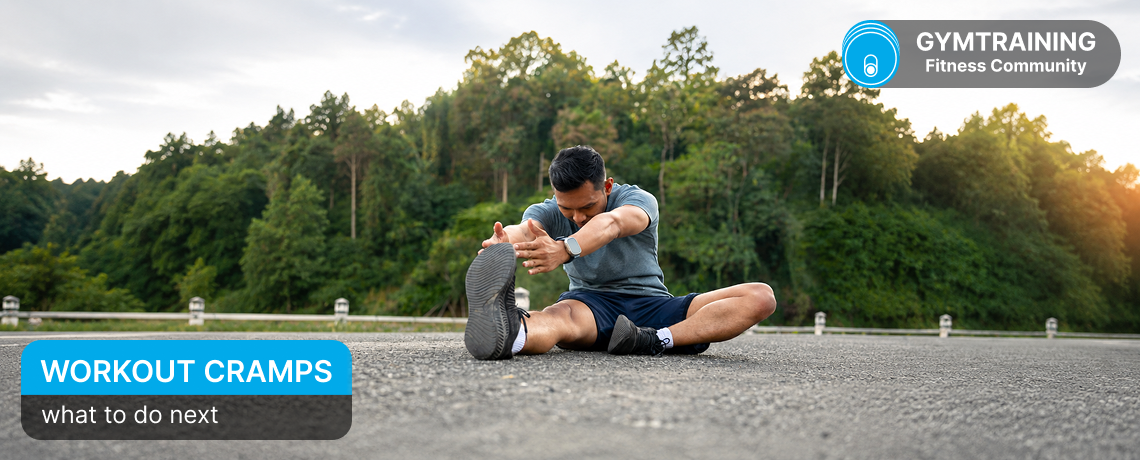
The last few reps of a set are getting harder, your form starts to break down — and suddenly your calf or hamstring tightens into a painful cramp. The muscle becomes hard, movement is difficult, and continuing the exercise may be impossible.
If a muscle cramps during exercise, stop the activity and slowly stretch the affected muscle until the contraction begins to ease. If the cramp resolves completely and movement does not cause pain or noticeable weakness, you can cautiously test the area with very light activity. If the muscle cramps again, stop training that muscle group for the rest of the session.
Magnesium or potassium deficiency is often blamed first for muscle cramps. In practice, however, exercise-associated muscle cramps rarely have a single cause. Local muscle fatigue, unfamiliar workloads, exercise technique, individual susceptibility, and training conditions may all contribute. During prolonged exercise in hot conditions, substantial fluid and sodium losses can also play a role.
This article focuses on localized, painful muscle contractions associated with physical activity — not seizures involving loss of consciousness.
Nighttime leg cramps, muscle spasms unrelated to exercise, and cramps caused by medical conditions require separate evaluation.
Below, we explain what to do during the first few minutes of a muscle cramp, when it may be reasonable to resume exercise, and what to change in future workouts to reduce the chance of recurrence. Because exercise-associated muscle cramps are considered multifactorial, analyzing the specific circumstances is usually more useful than relying on universal advice such as “just drink more water.”
Muscle Cramps During Exercise: Quick Guide
| Situation | What to Do |
|---|---|
| The muscle is still hard and contracted | Stop the activity and slowly stretch the muscle |
| The cramp has completely stopped | Test the movement without additional weight or resistance |
| Pain or noticeable weakness remains | Stop exercising that muscle group |
| The muscle cramps again | Do not return to loading that muscle during the session |
| You develop nausea, dizziness, or poor coordination | Stop exercising and move to a cool environment |
| Swelling or bruising develops after sudden pain | Do not load the area and consider the possibility of an injury |
What to Do When a Muscle Cramps During a Workout
The first priority is to stop the activity safely. Do not try to finish a repetition through the pain, maintain your running pace, or continue swimming while the muscle remains tightly contracted.
Once you have stopped, slowly move the affected muscle into a stretched position. The stretch should be noticeable but controlled. Avoid bouncing, jerking, or immediately forcing the muscle into its maximum range of motion. Hold the position until the contraction begins to ease.
Gentle static stretching until symptoms improve remains the main practical way to relieve an acute exercise-associated muscle cramp.
| Situation | What to Do First | What to Do After the Cramp Eases |
|---|---|---|
| Cramp while lifting weights or using a machine | Safely release or rack the weight and stop the set. Do not attempt to finish the repetition at all costs. | Rest for a few minutes, then test the movement without weight. |
| Cramp while running or cycling | Stop in a safe place and slowly stretch the affected muscle. | Start with easy walking or very light movement. Do not immediately return to your previous pace. |
| Cramp while swimming | Stay calm and get to the side of the pool, lane divider, or another stable support. | Stretch the muscle only after you are in a secure position. |
| Cramp during exercise in hot conditions | Stop exercising and move to a cooler environment. | Assess how you feel overall. If you have weakness, nausea, dizziness, or poor coordination, end the workout. |
You can gently massage the muscle with your hand once the acute contraction has started to release. Avoid deep pressure on a painful area, aggressive foam rolling, or stretching through sharp pain.
What to Do for a Calf Cramp
Move slowly and stop stretching if the pain becomes sharp or feels different from a typical muscle cramp.
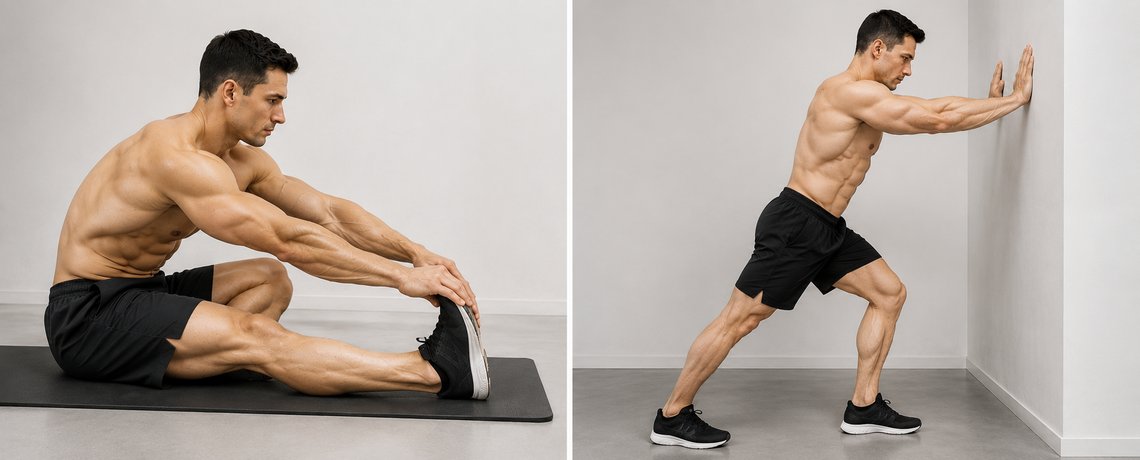
Sit down and straighten your leg at the knee. Slowly pull your toes toward you until you feel a stretch along the back of the lower leg. Do not point your toes away from you, as this shortens the calf muscle further.
Another option is to place the affected leg behind you, point your toes forward, and gradually lower your heel toward the floor. Lean your torso slightly forward while keeping the back knee straight. If cramps regularly occur during calf work, review the technique for standing calf raises before increasing the load.
What to Do for a Hamstring or Quadriceps Cramp
A hamstring cramp can be stretched by carefully straightening the leg, while a quadriceps cramp can be relieved by gently bending the knee and bringing the heel toward the buttock.
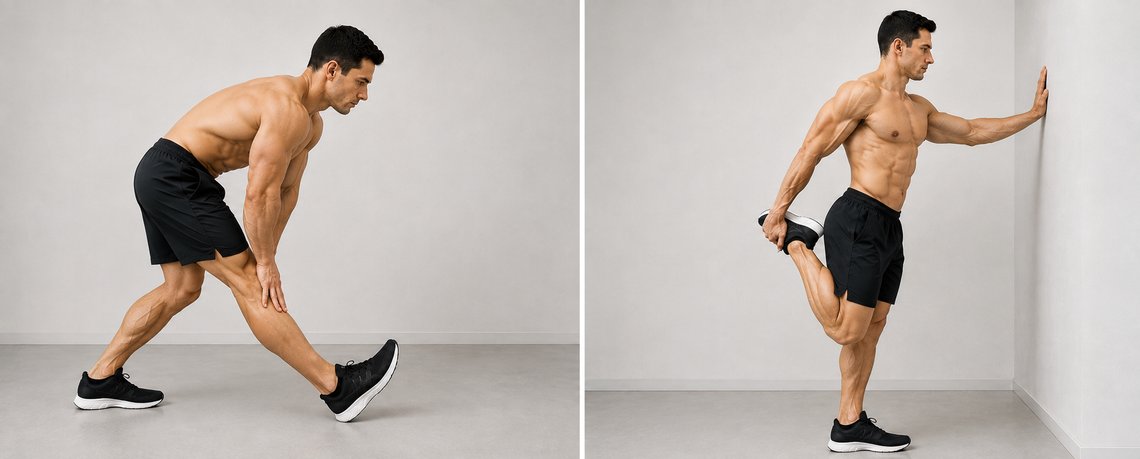
For a hamstring cramp, carefully straighten your leg and lean your torso slightly forward. Do not push down on the knee with your hands or force your chest toward your thigh.
For a quadriceps cramp, hold onto a stable support, bend your knee, and slowly bring your heel toward your buttock. Try to keep your knees close together and avoid excessively arching your lower back.
In both cases, a position that creates a moderate stretch and allows the muscle to gradually relax is enough. Avoid sudden pulling or trying to increase your range of motion immediately, as this may worsen the pain.
What to Do for a Foot Cramp
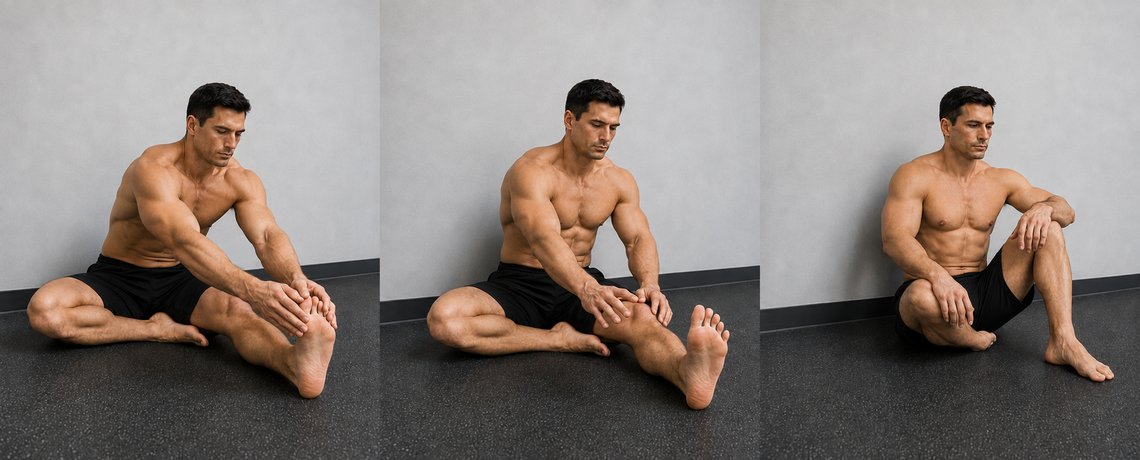
Sit down, straighten your leg, and gently pull your toes toward you. Hold the position until the cramp eases, then slowly move your toes.
Do not suddenly put your full body weight on the cramped foot. First place it carefully on the floor and make sure you can bear weight normally.
Can You Continue Exercising After a Muscle Cramp?
There is no universal test that can guarantee it is safe to resume exercise after a muscle cramp. The decision should be based on how the muscle feels and functions after several minutes of rest.
You may cautiously test light activity if:
- the contraction has completely stopped;
- the muscle no longer feels hard or tightly contracted;
- normal movement has returned;
- there is no sharp pain;
- there is no noticeable weakness;
- you otherwise feel well.
Start by testing a simple movement without additional weight or resistance.
After a calf cramp, walk slowly and try a few easy calf raises. After a thigh cramp, gently bend and straighten the leg several times through a comfortable range of motion.
If movement does not cause pain or obvious weakness, you may cautiously return to the workout. However, do not immediately resume your previous weight, pace, or training volume. Reduce the workload and avoid taking the next set to muscular failure.
This is a practical guideline, not a guarantee that continuing the workout will be safe in every situation.
When You Should Stop Exercising the Affected Muscle
Do not return to loading the affected area if:
- the cramp returns;
- sharp localized pain remains;
- you develop noticeable weakness;
- you lose normal control of the movement;
- the muscle does not relax after rest and gentle stretching;
- you start feeling unwell overall.
Why Do Muscles Cramp During Exercise? Four Main Groups of Factors
There is no single proven cause of exercise-associated muscle cramps. In most cases, a combination of internal and external factors appears to contribute, and the combination may differ even in the same person from one workout to another.
1. Muscle Fatigue and Unfamiliar Exercise
A common scenario is a cramp near the end of a difficult set, long-distance effort, or prolonged activity in the same position. The muscle is already significantly fatigued, movement becomes less controlled, yet the athlete tries to maintain the same pace or complete the final repetitions.
This can also happen after returning to training, learning a new exercise, or performing a type of activity your body is not accustomed to. A strength athlete is not necessarily prepared for prolonged running, just as a runner may not be accustomed to a high volume of squats, lunges, or calf raises.
If the same muscle regularly cramps near the end of the same exercise, pay attention to exactly when the problem starts. Your technique may already be deteriorating, your range of motion may be becoming less controlled, or the muscle may be spending too long in a shortened position.
2. Increasing Training Load Too Quickly
The problem does not always appear after adding one new exercise. Often, several training variables are increased at the same time.
For example, someone may increase the working weight, add another set, train legs more frequently, and increase running mileage at the same time. Each change may seem minor on its own, but together they can create a workload the muscles have not yet adapted to.
Avoid increasing several training variables simultaneously. Increase weight, repetitions, total volume, frequency, or pace gradually and monitor how your body responds to each change. Read about when to increase the amount of weight you lift and avoid common training-program mistakes that can make workload management harder.
For running, avoid sharply increasing distance, speed, and training frequency at the same time.
3. Exercise Technique and Muscle Position
Sometimes a muscle cramp occurs repeatedly only during a specific movement or in a particular position.
The calf may cramp when the foot remains pointed for too long. The muscles of the foot may cramp if the toes remain tense and constantly try to grip the floor.
If the problem repeatedly occurs during one exercise, check whether it appears after your technique begins to deteriorate, you lose control of the range of motion, or the muscle remains in a shortened position for too long.
In this situation, reducing the load slightly and identifying when uncontrolled tension begins to accumulate is often more useful than searching for a universal mineral supplement. Pay particular attention to joint position, range of motion, and whether your technique starts to break down as fatigue increases.
4. Training Conditions and Individual Susceptibility
Some people experience exercise-associated muscle cramps more frequently than others. Previous cramping history, current conditioning for a specific activity, pace, exercise duration, and environmental conditions may all influence risk.
During prolonged, intense exercise in the heat, sweat causes losses of both water and sodium. However, this does not mean that every muscle cramp should automatically be attributed to dehydration or electrolyte deficiency.
Prevention should focus on the pattern that repeatedly triggers the problem. One person may benefit from increasing running pace more gradually, another from reducing the number of sets taken to failure, and another from adjusting fluid and sodium intake during prolonged exercise in hot weather.
An individualized assessment is usually more useful than giving everyone the same advice.
Magnesium, Water, and Sports Drinks for Muscle Cramps
Magnesium, potassium, calcium, and sodium all play important roles in normal nerve and muscle function. However, a single muscle cramp cannot tell you which nutrient you may be lacking — or whether a deficiency exists at all.
Should You Take Magnesium After a Muscle Cramp?
A single cramp during a hard set does not prove that you are deficient in magnesium. Evidence supporting magnesium specifically for preventing exercise-associated muscle cramps is insufficient.
For that reason, there is generally no basis for taking a magnesium supplement solely because a muscle cramped once during a workout.
This does not mean magnesium deficiency never occurs. However, diagnosing a deficiency from one symptom and choosing supplements at random is not a reliable approach.
Do Water and Sports Drinks Help With Muscle Cramps?
Water or a sports drink will not instantly relax a muscle that is already cramping. The first steps are to stop the activity and gently stretch the affected muscle.
During a relatively short strength-training session in a comfortable indoor environment, water is usually sufficient. Fluid requirements depend on exercise duration, temperature, sweating rate, and individual needs.
During prolonged activity in hot weather, a drink containing both fluid and sodium may be useful. Whether carbohydrates are also needed depends on the duration and intensity of the exercise. See how much water you should drink during exercise for a fuller discussion of hydration.
A single calf cramp after a difficult set and cramps affecting several muscles during a multi-hour endurance event in hot conditions should not be evaluated in the same way.
Does Eating a Banana Help With Muscle Cramps?
A banana can be a normal part of a pre- or post-workout meal because it provides carbohydrates and potassium. However, it is not a rapid treatment for a muscle cramp that has already started.
Instead of searching for one “anti-cramp” food, it is more useful to evaluate the situation as a whole:
- how the workout was structured;
- how different it was from your usual training;
- whether the workload increased too quickly;
- whether your technique was deteriorating;
- whether you had enough time to recover;
- whether the workout took place in hot conditions.
How to Prevent Muscle Cramps in Your Next Workout
There is no guaranteed way to prevent exercise-associated muscle cramps. Practical prevention starts by examining the circumstances in which the cramp occurred.
Step 1. Reconstruct What Happened
Try to remember or write down:
- which exercise you were doing;
- which set, repetition range, or kilometer you had reached;
- what weight or pace you were using;
- how many repetitions you had already completed;
- whether your technique had started to deteriorate;
- how different the workout was from your normal routine;
- whether the environment was hot or poorly ventilated.
Step 2. Temporarily Reduce the Training Load
During your next workout, consider reducing one variable:
- working weight;
- number of sets;
- number of repetitions;
- pace or speed;
- exercise duration;
- number of sets taken to muscular failure.
You do not necessarily need to reduce everything at once. Choose the variable most likely to be associated with the cramp.
Step 3. Avoid Taking the Problematic Set to Complete Failure
If the muscle usually cramps during the final repetitions of a set, stop the set slightly earlier while your technique and movement control are still intact. This is particularly relevant if you use training to failure frequently.
After several symptom-free workouts, you can gradually increase the training load again.
Step 4. Use a Specific Warm-Up
Before heavy strength training, perform movements similar to the exercise you are about to do and complete several gradual warm-up sets. See the basics of a proper warm-up before strength training.
A good warm-up should progressively prepare you for the working weight rather than fatigue your muscles before the main part of the workout begins.
Step 5. Check Your Technique and Joint Position
Pay attention to whether the problem occurs only:
- at a particular range of motion;
- with a specific foot position;
- when the muscle stays shortened for a prolonged period;
- after you lose control of your torso or body position;
- when using a particular exercise machine.
If necessary, reduce the load and review your technique on your own or with a qualified trainer. Foot placement, joint positioning, and movement control can be particularly important during exercises such as the leg press; review common leg press mistakes before increasing the load.
Step 6. Consider Recovery
Several hard workouts in a row, repeatedly training to failure, and insufficient recovery can reduce your ability to tolerate even a workload that would normally feel manageable. If accumulated fatigue is becoming a recurring problem, review the basics of post-workout recovery.
Step 7. Consider the Training Environment
During prolonged exercise in hot weather, consider the duration of the activity, how much you are sweating, and whether you have access to water or a sodium-containing drink.
However, do not try to prevent every recurring muscle cramp simply by drinking more water. There is no single hydration strategy that is appropriate for every person and every type of workout.
Step 8. Evaluate the Result
If the problem disappears after you modify the training load, warm-up, or technique, gradually return to your previous training volume.
If cramps continue to occur regularly in the same muscle, appear outside exercise, or are accompanied by other symptoms, consider discussing the issue with a healthcare professional.
Does Stretching Help Prevent Muscle Cramps?
Regular stretching can improve flexibility, but stretching alone does not guarantee protection against exercise-associated muscle cramps.
Its main practical role in this situation is to gently relax a muscle that is already cramping.
For prevention, it is generally more important to:
- choose a training load appropriate for your current fitness level;
- increase training volume gradually;
- maintain good exercise technique;
- account for overall fatigue;
- identify recurring triggers.
Muscle Cramp, Muscle Injury, or Heat Illness?
Not every episode of sudden muscle pain is a typical exercise-associated cramp. The table below can help you recognize important differences, but it is not intended for self-diagnosis.
| What to Look For | More Consistent With a Typical Exercise Cramp | Possible Muscle Injury | Possible Heat-Related Illness |
|---|---|---|---|
| How it started | The muscle suddenly contracted and became hard | Pain began during a sudden movement, acceleration, or heavy lift | Symptoms developed during exercise in a hot or poorly ventilated environment |
| What happens after stopping | The contraction gradually eases with gentle stretching | Pain continues even after the muscle is no longer contracted | General weakness, headache, nausea, or dizziness remains |
| Movement | Usually returns after a short period of rest | Remains painful or noticeably weak | Coordination, speech, or orientation may be affected |
| Visible signs | Rapid swelling or bruising is usually absent | Swelling, bruising, or a popping sensation may occur | The skin may feel hot; sweating may be heavy or abnormal |
| What to do | Relax the muscle and test gentle movement once symptoms resolve | Stop exercising and avoid loading the painful area | Move to a cooler environment and begin cooling; seek emergency medical help for severe symptoms |
If severe localized pain remains after what seemed to be a cramp, bruising develops, or it becomes difficult to bear weight on the leg, do not continue exercising. These signs may indicate a muscle injury rather than a typical exercise-associated cramp.
What to Do About Muscle Cramps in Hot Weather
If muscle cramps are accompanied by significant weakness, headache, nausea, or dizziness, stop exercising, move to a cooler environment, and remove unnecessary clothing.
Begin cooling with cool water, wet towels, or airflow. A person who is feeling significantly unwell should not be left alone.
Confusion, difficulty speaking, loss of consciousness, or a generalized seizure during heat exposure may be signs of heat stroke. This is a medical emergency. Call emergency medical services and begin cooling immediately.
When to See a Healthcare Professional About Muscle Cramps
A single short-lived cramp after hard or unfamiliar exercise will often resolve after you stop the activity and gently stretch the muscle.
Consider seeking medical advice if the cramps:
- occur regularly;
- appear without an obvious connection to physical activity;
- frequently wake you at night;
- do not resolve for a long time after stopping exercise;
- repeatedly affect only one limb;
- are accompanied by numbness;
- occur together with persistent weakness;
- are associated with swelling, redness, or changes in skin color.
After a possible muscle injury, seek medical attention if the pain remains severe, swelling increases rapidly, bruising develops, or you cannot use the affected limb normally.
Frequently Asked Questions About Muscle Cramps During Exercise
Why Do I Get Muscle Cramps at the End of a Set?
By the end of a demanding set, the muscle has accumulated significant fatigue and movement control may begin to deteriorate. At the same time, you may still be trying to maintain the same weight, pace, and range of motion.
If the problem repeatedly occurs during the final repetitions, try reducing the weight or ending the set slightly earlier.
Why Does the Same Muscle Keep Cramping?
Repeated cramps in the same muscle may result from a combination of individual susceptibility, the mechanics of a particular exercise, muscle position, a rapid increase in training load, and insufficient adaptation to the current workload.
Keep track of which exercise, weight, pace, and repetition range are associated with the problem. Also pay attention to your range of motion, foot position, and overall technique.
If one side cramps outside exercise as well, or if the symptoms are accompanied by weakness, numbness, or skin-color changes, discuss the problem with a healthcare professional.
Do I Need to Stop the Entire Workout After a Muscle Cramp?
Not always. If the cramp has completely resolved, normal movement has returned, and you have no pain or noticeable weakness, you can cautiously test the area with a lighter load.
If the muscle cramps again, stop training that area. If you feel generally unwell, stop the entire workout.
Should I Stretch More Often to Prevent Cramps?
Regular stretching can improve flexibility, but it does not guarantee that exercise-associated muscle cramps will not occur.
In this context, stretching is primarily useful for gently relaxing a muscle that is already cramping. For prevention, gradual increases in training load, good technique, appropriate recovery, and identifying recurring triggers are generally more important.
Do I Need Blood Tests After One Muscle Cramp?
A single cramp after hard or unfamiliar exercise does not by itself identify a mineral deficiency and is usually not a sufficient reason to order tests or start taking supplements on your own.
If cramps occur regularly, happen outside exercise, or are accompanied by other concerning symptoms, discuss whether further evaluation is appropriate with a healthcare professional.
Key Takeaways
An exercise-associated muscle cramp is a painful, involuntary muscle contraction that occurs during or shortly after physical activity.
If a muscle cramps during a workout, stop the exercise safely and slowly stretch the affected muscle until the contraction begins to ease. Do not immediately return to the same weight, pace, or intensity.
If the cramp resolves completely and movement causes no pain or noticeable weakness, you can cautiously test the area with a light load. If the muscle cramps again, stop loading that muscle group for the rest of the workout.
There is no single cause of exercise-associated muscle cramps. Muscle fatigue, unfamiliar activity, rapid increases in training load, exercise technique, muscle position, individual susceptibility, and environmental conditions may all contribute.
Magnesium, bananas, water, and sports drinks should not be considered universal treatments for muscle cramps. In typical training conditions, gradual progression, an appropriate warm-up, good exercise technique, and sufficient recovery are more important. When cramps repeatedly occur, analyze your training load, technique, warm-up, recovery, and the conditions in which the problem develops.
Persistent pain, noticeable weakness, swelling, bruising, impaired coordination, and signs of heat illness require additional attention.
References
- Miller K.C., McDermott B.P., Yeargin S.W., Fiol A., Schwellnus M.P. An Evidence-Based Review of the Pathophysiology, Treatment, and Prevention of Exercise-Associated Muscle Cramps. Journal of Athletic Training. 2022;57(1):5–15.
- Miller K.C., Stone M.S., Huxel K.C., Edwards J.E. Exercise-Associated Muscle Cramps: Causes, Treatment, and Prevention. Sports Health. 2010;2(4):279–283.
- Garrison S.R., Korownyk C.S., Kolber M.R. et al. Magnesium for Skeletal Muscle Cramps. Cochrane Database of Systematic Reviews. 2020;9:CD009402.
- Centers for Disease Control and Prevention, National Institute for Occupational Safety and Health. Heat-Related Illnesses: Symptoms and First Aid.