Want legs that power your performance, turn heads, and boost your confidence? Leg day can feel daunting, but machine-based exercises make it approachable, safe, and highly effective for sculpting strong quads, glutes, and hamstrings — whether you're a beginner sidestepping free-weight risks or an advanced lifter chasing bigger gains. This guide dives into four powerhouse machines, unpacking their mechanics, benefits, and pro tips to help you maximize results and avoid common mistakes. Ready to transform your lower body? Let’s hit the gym!
Comparing the Top Leg Machines
| Machine | Primary Focus | Key Advantage | Best For |
|---|---|---|---|
| Machine Squat | Quads, Glutes | Back safety, natural movement path | Building overall leg mass as a barbell alternative |
| Hack Squat | Quads (outer sweep) | Deep range of motion, lower back protection | Targeted quad development |
| Leg Press | Quads | Maximum isolation, heavy weight capability | Finishing quads, Training to failure |
| Glute Kickback Machine | Glutes | Complete glute isolation, knee safety | Shaping and strengthening glutes |
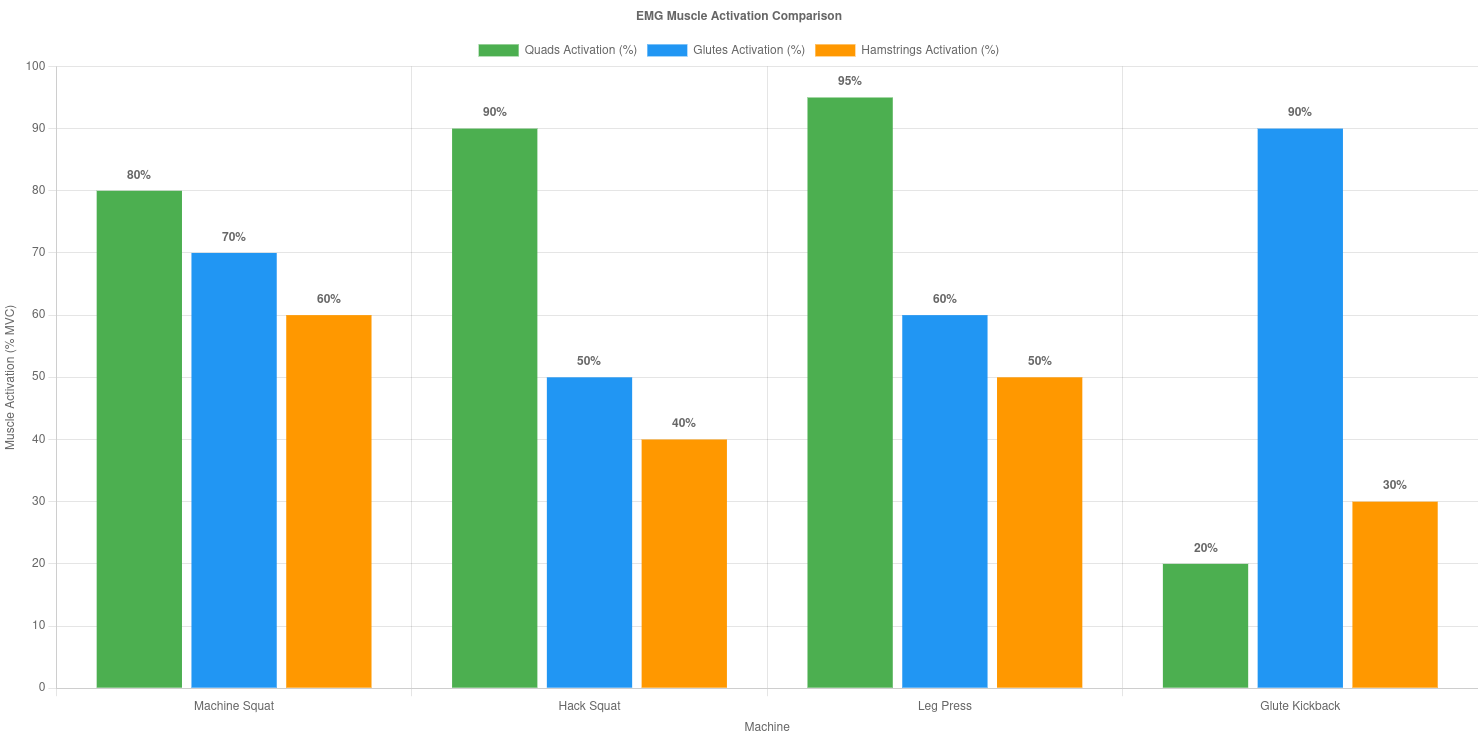
Muscle Activation by Leg Machine
1. Machine Squat
This exercise mimics classic squats but with back support and a guided path, letting you focus on your quads, glutes, and hamstrings without stressing your back.
Why It's Effective
Machine squats reduce pressure on the lower back, making them safer for those with back concerns. Foot placement shifts focus: low on the platform for quads, high and wide for glutes and hamstrings.
Execution Technique
Position your feet shoulder-width on the platform, shoulders under the pads. Lower by bending your knees until thighs are parallel to the floor, then push up smoothly without locking your knees.
Experience Levels and Intensity Tips
- Beginners: 3 sets of 12–15 reps with moderate weight to perfect form.
- Advanced: Use "1.5 reps" (full down, halfway up, full down, up) for 3 sets to increase time under tension.
Contraindications
Avoid deep ranges if you have knee or lower back issues — consult a professional first.
2. Hack Squat
The hack squat angles your body to protect the lower back while emphasizing quads and inner thighs with a deeper motion.
Why It's Effective
It targets the outer quads and vastus intermedius with a greater knee range, offering fuller muscle engagement than leg presses while keeping the back safe.
Execution Technique
Lie back against the pad, feet shoulder-width on the platform. Lower to a 90-degree knee angle, keeping your back flat, then press up without locking knees.
Experience Levels and Intensity Tips
- Beginners: 3 sets of 12–15 reps with light weight.
- Advanced: Perform partial reps in the top range with 20–25% extra weight for 3 sets of 6–8 to intensify quad burn.
Contraindications
Skip if you have knee or hip issues, as depth can stress joints. Warm up thoroughly.
3. Leg Press
A gym staple for quad isolation, the leg press fixes your torso to channel all effort into your legs.
Why It's Effective
It minimizes stabilizer use, maximizing quad focus. Foot placement alters emphasis: low for quads, high / wide for glutes and hamstrings.
Execution Technique
Sit with back and hips against the seat, feet on the platform. Extend legs without locking knees, then lower controllably. Avoid common errors with our guide on the 6 biggest leg-press mistakes solved.
Experience Levels and Intensity Tips
- Beginners: 3 sets of 10–15 reps.
- Advanced: End with drop sets — 10 reps, drop 20–25% weight, repeat — to spark growth.
Contraindications
Not ideal for lower back or knee pain; seek expert advice if discomfort arises.
4. Glute Kickback Machine
Often overlooked, this isolates glutes and upper hamstrings for targeted shaping.
Why It's Effective
It maximizes hip extension for strong glute activation with stable knee support, also engaging hamstrings more than leg presses.
Execution Technique
Lean into supports, place one foot on the platform. Push back, squeezing glutes, then return slowly. Switch legs. Explore more glute-focused moves in our guy's guide to great glutes.
Experience Levels and Intensity Tips
- Beginners: 3 sets of 12–15 reps per leg.
- Advanced: Alternate legs without rest for a pump effect.
Contraindications
Avoid with recent glute or hip injuries; prioritize form.
Modern Tips for Integrating Exercises
In 2025, combine machines with functional moves like lunges for better mobility. Post-session, prioritize recovery with stretching or foam rolling. Learn more in our guide on how to recharge your body between workouts.
Conclusion
Leg machines aren't just for beginners — they're precision tools for building strength, size, and symmetry safely. Master these four to crush plateaus and sculpt powerful, aesthetic legs. Ready to level up? Hit the gym, log your workouts, and join our community at gym-training.com to share your journey. Your stronger legs start today!
Frequently Asked Questions (FAQ)
How do you use the leg press machine correctly?
Sit with your back flat, feet shoulder-width on the platform. Push through heels without locking knees, exhaling on the push, inhaling as you lower slowly. Place feet low for quads or high for glutes. Start light to master form, avoiding errors like rounding your back.
Are hack squats better than regular squats or the leg press?
Hack squats target quads deeply with less back stress than regular squats, ideal for muscle imbalances. They engage more stabilizers than leg presses, mimicking functional movements. Combine with both for a balanced leg routine.
What are the best machines for building glutes?
Glute kickback machines isolate glutes best, while leg presses (high feet) and hack squats (wide stance) also target glutes effectively. Combine them for balanced growth.
How many sets should you do for leg exercises on machines?
For hypertrophy, do 3–4 sets of 8–12 reps with 60–90s rest, using a challenging weight. Beginners start with 2–3 sets of 12–15 reps. Vary reps weekly to avoid plateaus, and log progress.
Can beginners train legs on machines?
Yes, machines are beginner-friendly due to guided paths, reducing injury risk. Start with light weights, focus on slow reps, and train 1–2 times weekly. Avoid mistakes with our guide on 6 ways you're a serious workout injury waiting to happen.
Are machine squats safe for people with back or knee problems?
Machine squats are safer than free weights but consult a doctor for chronic issues. Use light weights, avoid deep ranges, and warm up for 5–10 minutes to protect joints.
How do you choose the right weight for leg machine exercises?
Pick a weight where the last 2–3 reps are tough but form holds. Beginners start light, increasing gradually. Test with a warm-up set, adjusting by 5–10% as needed.
Can leg machine exercises help with weight loss?
Yes, high-rep sets (15–20) with short rests burn calories, especially with large muscles like quads. Pair with a calorie-controlled diet. Check 3 reasons your diet isn't working for tips.
How can you avoid injuries during leg machine exercises?
Warm up for 5–10 minutes, keep your back straight, and use controlled movements. Stretch post-workout to reduce tightness. Stop at sharp pain and consult a professional.
How often should I train legs on machines?
Beginners train 1–2 times weekly with 48–72 hours rest. Advanced lifters can do 3, varying intensity. Prioritize sleep and nutrition for recovery.
Can I combine these with free weights for better results?
Yes, combine machines for isolation with free weights like lunges for stability. Alternate weekly for variety, and track progress to optimize gains without overuse.
How do I know when to change my leg workout routine?
Switch every 6–8 weeks if gains stall or motivation drops. Tweak exercises, reps, or weights to keep progressing, using periodization for long-term results.
Sources
- A Biomechanical Review of the Squat Exercise: Implications for Clinical Practice. PubMed, 2024.
- Evaluation of the Lower Limb Muscles' Electromyographic Activity during the Leg Press Exercise and Its Variants: A Systematic Review. PMC, 2020.
- Effects of Drop Sets on Skeletal Muscle Hypertrophy: A Systematic Review and Meta-analysis. SpringerOpen, 2023.
- Muscular Adaptations in Drop Set vs. Traditional Training: A Meta-analysis. ResearchGate, 2024.
- Loading Recommendations for Muscle Strength, Hypertrophy, and Local Endurance: A Re-Examination of the Repetition Continuum. PMC, 2021.